
York County Deed Records Show Recorded Transfers
Deeds and other land instruments for York County are recorded by the Circuit Court Clerk. A deed names the parties and the land conveyed. The description may point to a subdivision lot, a prior deed, a plat, or metes and bounds. Related instruments do different work. A deed of trust records a security interest, while a release or certificate of satisfaction documents what happened later. They sit side by side in the index.
| Deed Type | What It Does | Common Use |
|---|---|---|
| Conveyance deed | Transfers the described land or interest | Sale or other ownership change |
| Quitclaim deed | Transfers whatever interest the grantor holds | Family transfer or title cleanup |
| Executor or fiduciary deed | Records a transfer by an estate representative | Estate administration |
| Trustee or commissioner deed | Records a transfer made under a trust, court, or sale authority | Foreclosure, partition, or court sale |
| Deed of trust | Records a lender security instrument, not a sale deed | Loan, assignment, satisfaction, or release review |
York's index also lists mortgages, liens, UCC land filings, affidavits, acknowledgments, and releases. Recording proves entry into the land-record system. Legal effect depends on the document and any later filings. Read the full image. Reservations, exceptions, easements, and prior references can all change what a parcel carries, so a name-only match never proves a parcel is clear.
York County Search Fields Follow the Parties
The York Online Record Search offers Standard mode, Date or Name sorting, a category list, entity type, Grantor and Grantee fields, a start and end date, Book-Page or File number, page suffix, and instrument number. Party names take plain letters. Punctuation and spacing can change results. For a company, start with its legal name. Try a punctuation-free form next. For a person, initials or a prior surname may help when the deed language supports it.
| Search field | What it narrows | Use note |
|---|---|---|
| Grantor | Party conveying land | Try both individual and company spellings |
| Grantee | Party receiving land | Useful for an acquisition search |
| Category | Instrument family | Deed, mortgage, lien, UCC land, and related filings |
| Entity Type | Party class | Both, Company, or Human |
| Date range | Recording window | mm/dd/yyyy |
| Book/Page or Inst # | Known reference | Book type, page suffix, and file number may matter |
The categories cover several forms. These include DEED, MORT, LIEN, UCC LAND, ACK OF LIEN, AFFID HEIR, waiver, assignment, partial release, and termination forms. Not every label marks a plain sale. A complete check follows the deed. Then it searches liens, assignments, and satisfactions under the debtor, lender, trustee, or creditor. It also covers the current owner. The fields appear in the York deed search form.
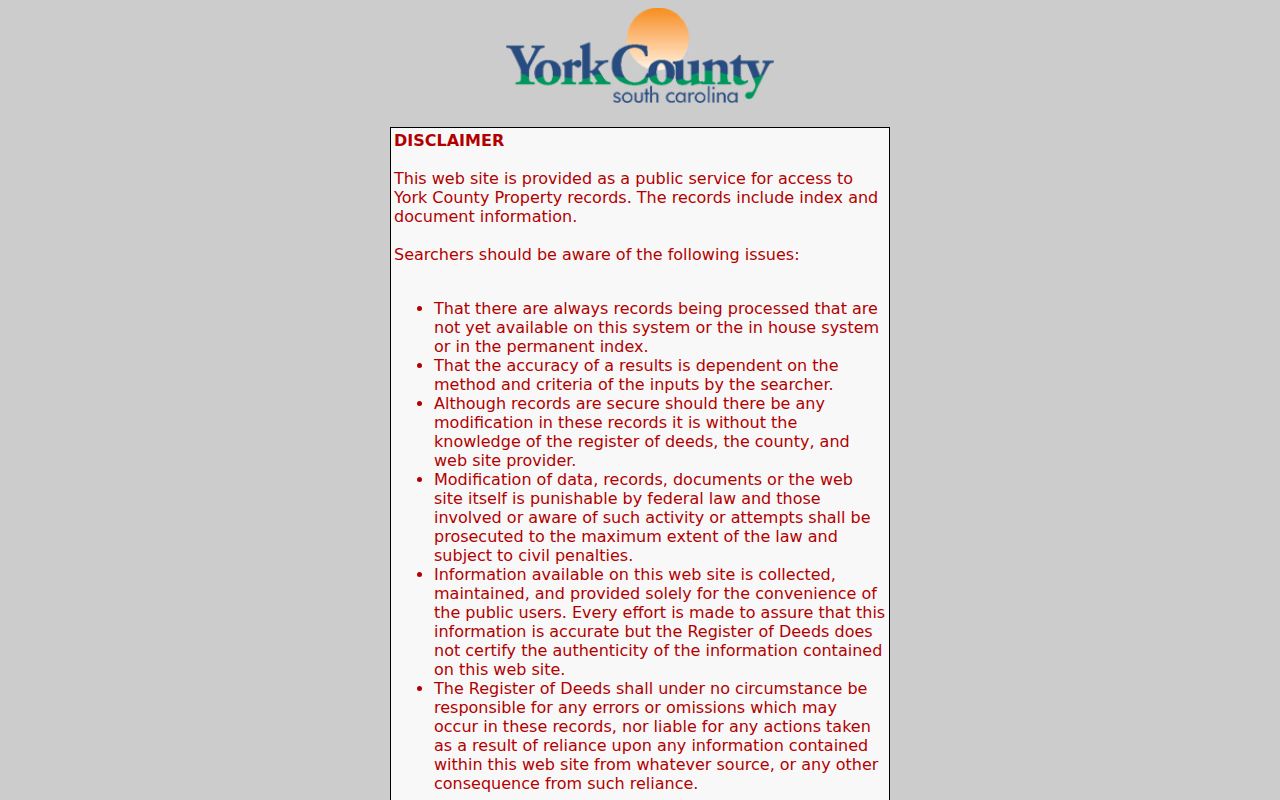
The image shows the official index entry point. It is not a sample deed, and open access to every recorded image is not guaranteed online.
The York County Grantor-Grantee Index
The grantor gives or conveys an interest. The grantee receives it. For a backward chain, start with the current owner's acquisition deed, where that owner appears as grantee. Read the grantor and the prior instrument reference. Then search that earlier party in both roles. Carry the legal description and book/page forward every time, and when a deed points to an old lot or tract name, compare the plat rather than expecting a modern street address in the older index.
- Search the present owner as grantee and locate the acquisition instrument.
- Read the grantor, legal description, recording date, and prior deed reference.
- Search the earlier party as grantee to find their acquisition, then as grantor to find a later conveyance.
- Repeat until the description changes or the index shifts to an older book series.
- Grantor
- The party conveying an interest in the instrument.
- Grantee
- The party receiving the described interest.
- Chain of title
- The linked sequence of recorded transfers for a parcel.
- Book/page and instrument number
- Two ways the Clerk's index identifies a recorded filing.
York County's Online Deed Years Overlap
The Clerk's SRA coverage table lists current Deeds and Land Records from August 1, 1953. Historical ranges sit beside that start date. OLD DEED BOOKS run from January 1, 1753 to February 24, 1932. Another book run spans December 1, 1910 to June 5, 1967. A further series covers 1957 to 1968. These ranges overlap rather than forming one modern search box. Pick the historical instrument group. Record the exact book, page, date, and index role.
Other instrument sets differ. Financing Statements start in 1995. General Miscellaneous starts in 1994. Judgments start in 1985. Marriage Licenses start in 1866. Wills and Fiduciaries start in 1967. A negative deed search answers no probate or judgment question. Match the record group to the document. Then ask the Clerk which index or image series holds a known older reference. The York Clerk's SRA coverage page lists every series and the subscriber route.
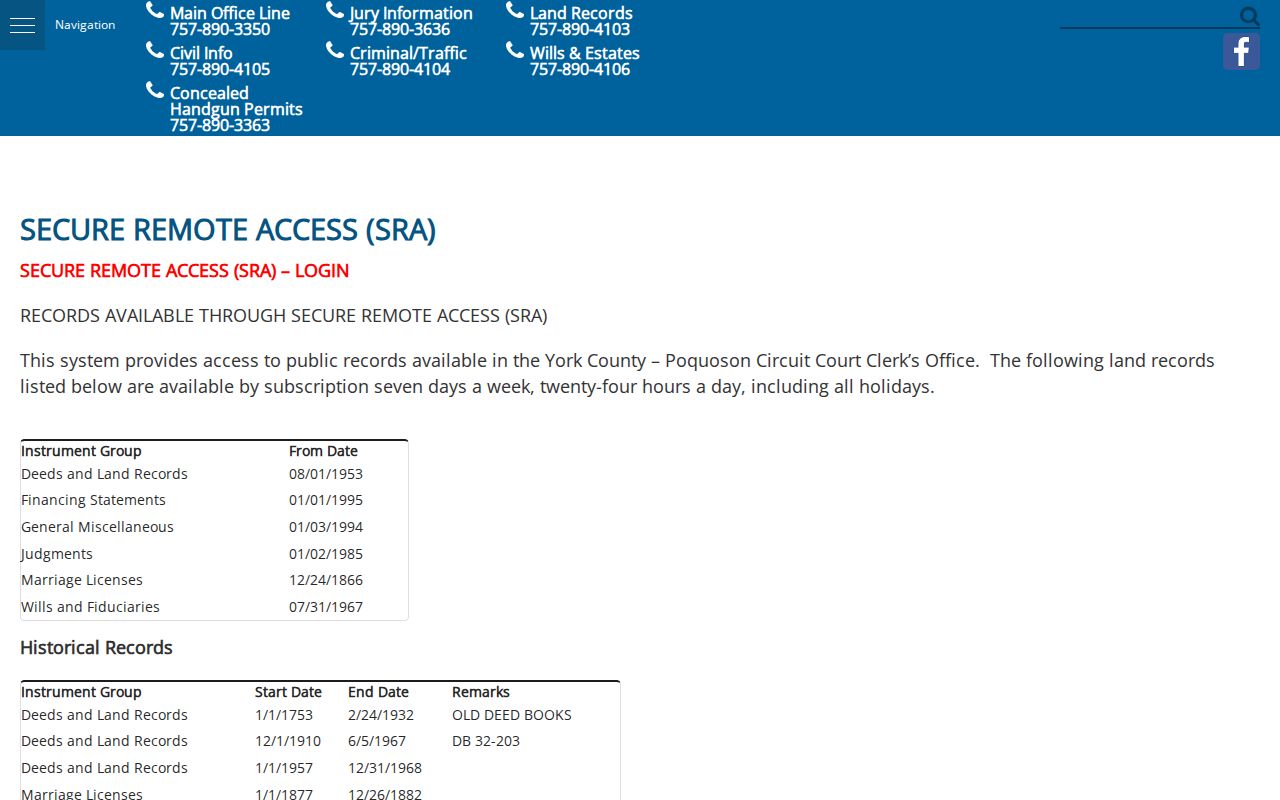
Treat the published date ranges as an index map. They are no promise that every historical page searches the same way.
Older York Deeds Lead to Microfilm
The Library of Virginia guide reaches back centuries for York County. Deed Book 6 covers 1777 to 1791, and early deeds and bonds run from 1701 to 1729. The General Index to Deeds spans 1777 to 1866. Grantor and grantee indexes run 1777 through 1956. Later years sit in other ranges. A Plat Book covers 1868 to 1951, and oyster-plat books span 1892 to 1954, useful in eras when no current GPIN or street name existed.
Some catalog entries are marked for interlibrary loan. Others require library or Clerk access. The finding aid does not promise free online viewing. Ask for the exact volume, index year, and book reference before traveling. Historic subdivision names, lot descriptions, water boundaries, and oyster plats can matter in York County's coastal record history. The Library of Virginia York County finding aid identifies the historical land-record collections.
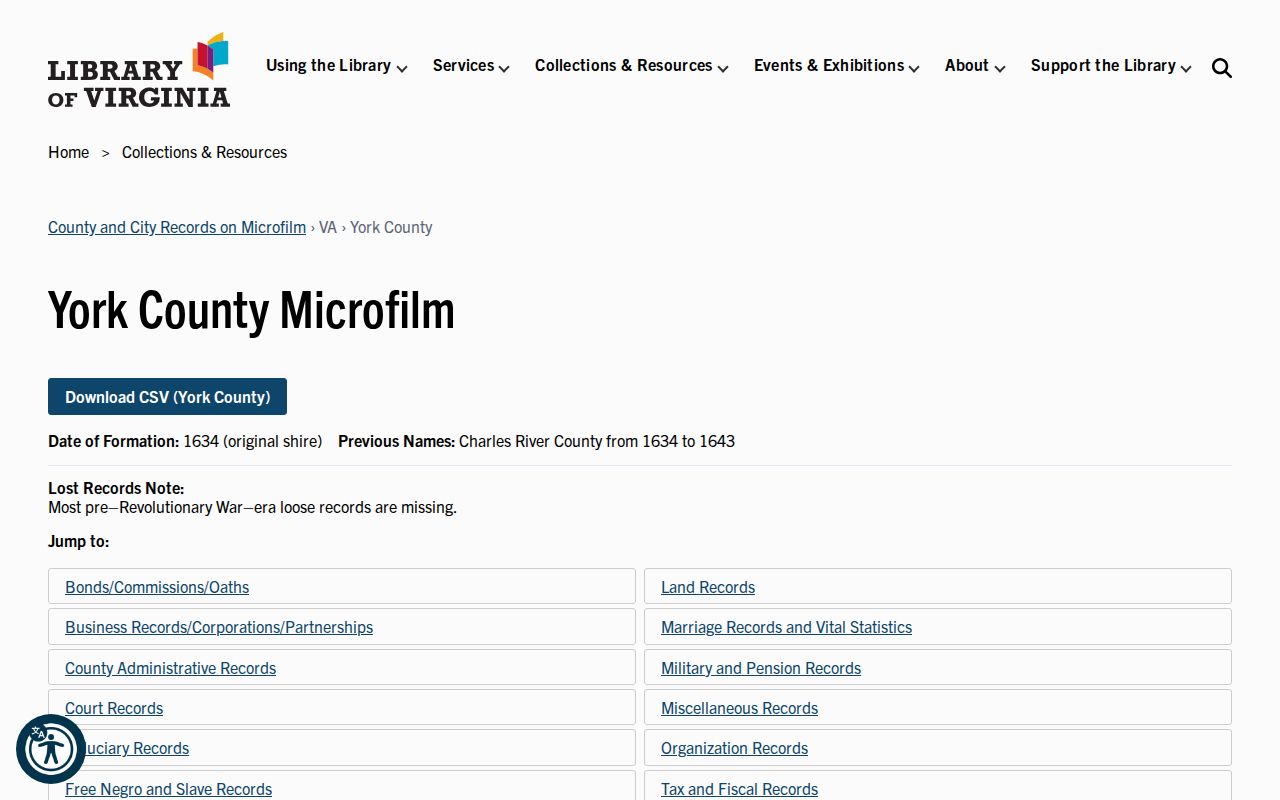
Carry an old deed's tract or lot description into the current parcel map with care. Check the intervening plats first.
York County Indexes Can Lag Filing
York County's online deed site posts an "Instruments Verified Through" date and time. Treat that stamp as a freshness marker. It does not promise that a deed filed minutes later appears instantly. The search page itself warns that some documents are still processing. The convenience data is not certified. A just-signed or just-recorded instrument may therefore call for a second check with the Clerk.
Recording dates and tax roll dates answer different questions. The deed records a transfer when the Clerk processes the instrument. The assessment side works on its own cycle. It takes effect each January 1 in even-numbered years. No official source states an average lag. The tax roll's catch-up time to a new owner of record is simply not published. When the two disagree, let the newest recorded instrument establish the transfer event. Then ask Assessment staff when the roll will reflect it.
York County Deed Copies and Access
A book, page, or instrument number makes the public index the fastest starting point. Remote images are a separate matter. York's SRA page lists a $50 monthly fee per user for subscription access, with an application and agreement, and notes that the Clerk reviews approval. Image access can hinge on that authorization. The $50 covers ongoing remote use, not a single certified document.
Virginia Code §17.1-275 sets recording fees by document length: $18 for instruments of 10 pages or fewer, $32 for 11 to 30 pages, and $52 for 31 pages or more. Paper or microfilm copies with no other fee run $0.50 per page. Electronic copies cost $0.50 per image. Certification, mailing, or local service charges should be confirmed before payment. Deed recording runs 8 a.m. to 3:45 p.m. on weekdays, inside the Clerk's broader 8 a.m. to 4 p.m. office hours.
For a certified copy or an older record, call Land Records at 757-890-4103 or visit the Clerk at 300 Ballard Street in Yorktown. Identify the parties, the date, the legal description, the book/page or instrument number, and whether certification is needed.
Estate Transfers Use Fiduciary Names
An owner's death does not end the deed trail. The land record may continue under an executor, administrator, trustee, commissioner, or estate name. Search the Wills and Fiduciaries series alongside the land-record index. York's SRA page carries that series from July 31, 1967. It also holds the marriage-license series from 1866. A probate file can explain why the assessment still shows a former name. But a will alone is not always the instrument that changes the record.
York's online categories include AFFID HEIR and related affidavits. Read the complete filing. Watch for a later fiduciary deed, confirmation, distribution, or court order. A death certificate fixes a date, yet it is not title evidence. Virginia VDH restricts recent death records and opens them after 25 years. Before then, eligibility and identification rules apply. The Virginia Department of Health vital-records page states those access rules.
Getting a Copy of a York County Deed
Three routes lead to a recorded deed image. Use the index when it supplies the reference you need. Request SRA access if remote image viewing justifies the subscription. Or simply ask the Clerk for a copy at the counter. A missing web result does not close the door. A public terminal or historical book may still serve. Give the Clerk the grantor and grantee names, the recording date, the book and page or instrument number, the parcel description, and the copy type wanted. Confirm the local total for certification, delivery, and any search time before paying.
Recorded, not guaranteed. The York County index is not certified and may omit records still in processing or interests that were never recorded. A title professional reviews the full chain and related filings before giving an opinion.